
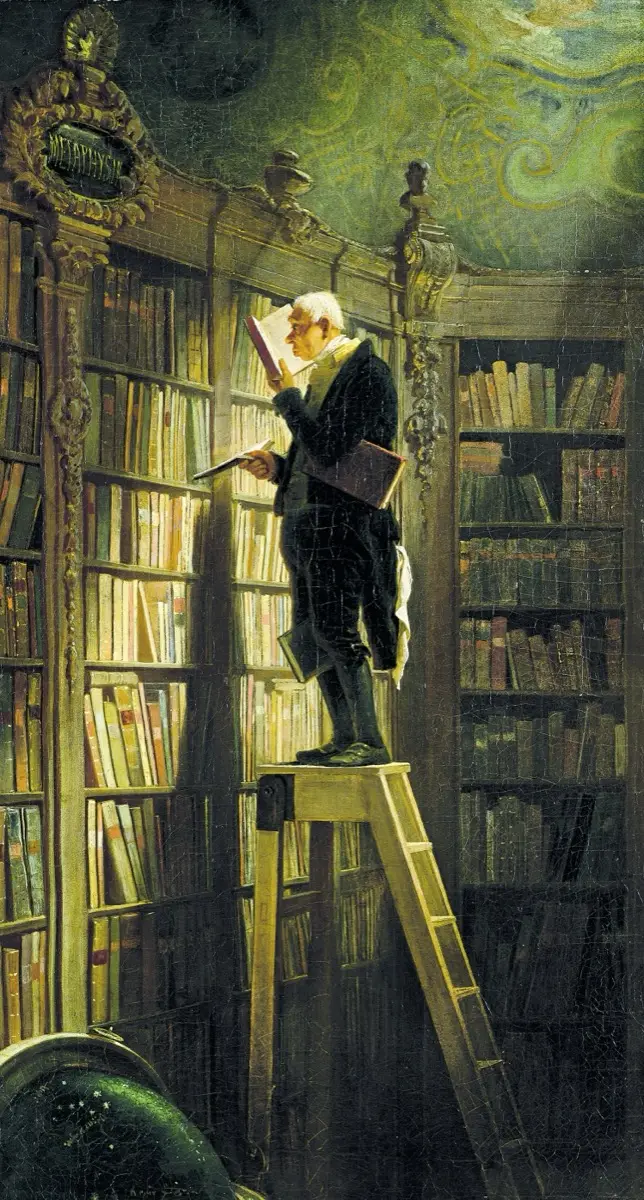
For fifty years, every machine built to help people find books was a megaphone. This is a short history of those machines, what they actually moved, and the one job none of them ever did.
Every engine was push
The most powerful book-discovery engine ever measured was a television segment. Between 1996 and 2011, Oprah's Book Club moved more than 22 million copies of its branded editions. When the club picked Say You're One of Them, the Oprah edition sold 405,000 copies against 47,500 for every other edition combined. A Million Little Pieces had sold 149,500 hardcovers in its life before selection; the Oprah edition sold 2.7 million.
Then an economist looked at the whole market instead of the chosen titles. Craig Garthwaite's NBER study found that Oprah endorsements were business-stealing, not market-expanding: total books purchased did not rise, and aggregate adult fiction sales actually declined in the weeks after an endorsement. The strongest push in publishing history changed which books sold. It did not make more readers.
The next two decades industrialized the same shape. Amazon's also-boughts and Goodreads recommended by similarity: people who bought this bought that, a mirror pointed backward at what already sold. Then BookTok arrived and proved the megaphone still works at even stranger magnitudes. BookNet Canada tracked twenty backlist titles that trended on the hashtag: print sales up 1,047% in aggregate over three years. Cain's Jawbone, a puzzle book from 1934, rose 235,600% from its near-zero base. Those percentages are month-against-month spikes on titles selected precisely because they trended, so read them as resurrection power rather than steady revenue. But the shape is unmistakable, and it is the same shape as 1996: the trend chooses, the reader receives.
Push discovery decides which books win. It has never been shown to grow reading itself.
The librarian never scaled
The demand side of discovery has always existed, but as a person, not a product. Librarians call it readers' advisory: the interview where someone tells you where they are in their life and you hand them the right book. It is a craft with a literature and a training tradition. It never became infrastructure.
The tools that tried say the quiet part themselves. Whichbook, built by the UK's reader-development movement, explains its own premise: a conventional search "is likely to turn up books you've already heard about," so it removed author and title search entirely. What it offers instead is sliders — mood, plot shape, setting. A digitized advisory form. On the American Library Association's official readers'-advisory tools page, the one automated recommender listed takes a book you already liked and finds similar ones. Similarity again, sliders again.
Five decades of software produced no way to hand a machine the thing a reader actually has: a situation. "I have to make a hard call this week." "I stopped being able to sit with books and I miss it." The question was never askable, because no surface could take it as input. The librarian stayed human, and therefore stayed small.
When the format moves, reading grows
There is a counter-history to the stagnation story, and it is about form. The paperback put books in coat pockets at pocket-money prices and mass readership followed. The pattern repeated in our own decade: in 2024, US digital audiobook revenue grew 22.5% to $2.36 billion — the format's largest jump on record — while ebooks grew 1.8% to $2.11 billion. For the first time, Americans spent more on hearing books than on reading them digitally.
The audiobook kept reinventing its surface: the phone, the commute, the app. The ebook page, meanwhile, has looked essentially the way it looked on the 2007 Kindle. The lesson from both the paperback and the audiobook is the same: reading demand responds to surface innovation, not to marketing. When the form meets people where they already are, the market grows. The ebook stopped meeting anyone anywhere new a long time ago.
Indexing the written word
Underneath discovery sits a harder question: who is even allowed to search inside the books? Project Gutenberg began hand-typing the public domain in 1971. LexisNexis sold full-text search of law and news from 1973. Amazon's Search Inside the Book — 2003, a year before Google Books — indexed a hundred thousand titles for one reason: search sells copies. Google then scanned some forty million books and spent a decade in court over it; the settlement of law that emerged says scanning to index is fair use, but display beyond snippets is not. HathiTrust's academic corpus won on the same line. The Internet Archive tried the next step, lending out its scans, and the Second Circuit shut that down in 2024. The shadow libraries simply showed everything and can never be businesses.
Then the ground moved. Anthropic bought millions of print books, cut off their bindings, scanned them, and in 2025 a federal judge ruled that training on lawfully purchased scans is "quintessentially transformative" fair use — while the pirated library alongside it produced the largest copyright settlement in history, $1.5 billion, roughly $3,000 a book. Fifty years of this history compresses to one sentence: indexing text is a solved technology and an unsolved permission. Everyone who indexed converged on one of four positions — index but don't display, public domain only, licensed, or shadow. Exactly one company has ever held the full stack of index, display, and payment at once: Amazon, through Search Inside, Kindle samples, and Kindle Unlimited's per-page payouts.
The surface where pull exists
The chat surface changed the input. People type situations into ChatGPT and Claude all day — the exact utterance readers' advisory was built around and software could never accept. And the surface now demonstrably converts that intent. Vercel's founder reported ChatGPT going from under 1% of new signups in late 2024 to 10% by April 2025. When ChatGPT launched apps in October 2025, the mechanic was explicit: discuss buying a home and it can surface Zillow mid-conversation; OpenAI's pitch to builders is reaching hundreds of millions of users "at just the right time." Shopping queries there are situation-shaped by design — "gifts for a ceramics lover." And with Instant Checkout, the purchase itself completes inside the chat.
Now look at the launch roster: Booking.com, Canva, Coursera, Figma, Expedia, Spotify, Zillow, and eleven more announced behind them. Travel is claimed. Design is claimed. Music went to Spotify on day one. Scan both lists for books and you find nothing. Every category is getting its recommended-and-fulfilled-in-chat moment, and the shelf where books should be is empty.
Proven, better, new
Mark Pincus has a test for timing in Life at the Speed of Play: the strongest products are proven behaviors, made better, on a new surface. This history assembles into exactly that. Proven: book discovery moves markets at tenfold and thousandfold magnitudes per title, and the industry already pays for reading by the unit — Kindle Unlimited divides a monthly fund by pages read, structurally the same pooled royalty Spotify uses for streams. Better: pull instead of push — a reading assembled from the reader's stated situation, in the authors' actual words, instead of a trend deciding for them or a model paraphrasing at them. New: the chat surface, where the situation is already typed and the answer can be read, and soon bought, without leaving.
Coffeetable is a bet on that assembly: you bring the question, it brings the real pages, woven across books, rendered like a Kindle page inside the conversation. The librarian, finally built, on the surface where the questions already live.